

WATCHTOWER · INVESTIGATION AND REMEMBRANCE
Quick facts
On October 29, 1956, Israeli Border Police killed Palestinian civilians in Kafr Qasim after the authorities moved up a curfew while people were away at work. The town remembers 49 losses. Eight men were convicted. All eight were free by March 4, 1960.
The victims, orders, verdicts and releases
- The people · The trial archive records 47 people killed by gunfire at Kafr Qasim. The town's commemorated toll also includes Fatma Daoud Sarsour's unborn child and ‘Abdallah Suleiman ‘Issa, who died hours later.
- The order · Col. Issachar Shadmi imposed the earlier curfew. Maj. Shmuel Malinki passed down the lethal enforcement order. Lt. Gavriel Dahan directed the force at Kafr Qasim. Shalom Ofer led men in several shootings.
- The verdicts · Eight Border Police defendants were convicted. A separate court acquitted Shadmi of murder and reprimanded and fined him for exceeding his authority.
- The releases · Military appeals, a chief of staff's reductions, presidential clemency and early release provisions cut the time served. Ben-Gurion recommended clemency for the three principal defendants.
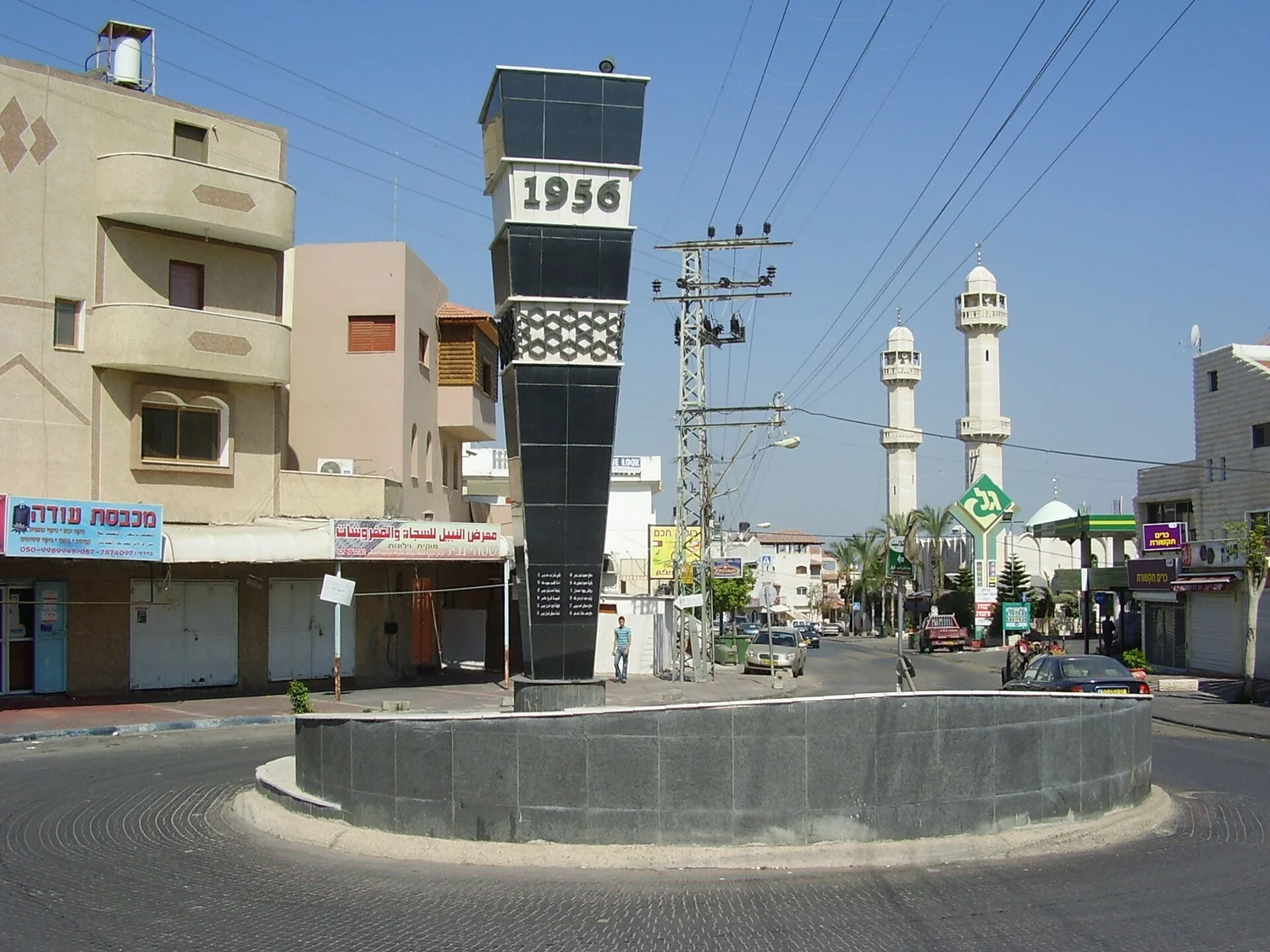

They were coming home
Ahmad Muhammad Frij and his brother Mahmoud had spent the day working at a quarry. They were riding home to Kafr Qasim with two other men when Israeli Border Police opened fire. Ahmad was killed. So was ‘Ali Othman Taha. Wounded, Mahmoud pulled his bicycle over himself and lay still. ‘Abdallah Samir Bdeir dropped to the ground, survived, and later told the court what he had seen. The judges found that the four were peaceful civilians. The police had given them no order to stop before firing. Trial evidence reconstructed by Akevot.
Riyad Raja Hamdan was eight. Jamal Salim Taha was eleven. According to the archive's reconstruction, the boys had urged adults at the vegetable gardens to finish up and go home early. They were among the people killed returning in a truck. Inside the village, Talal Shaker ‘Issa was shot near his home while trying to bring goats back. His father, mother and sister were wounded as the family tried to help. The prosecution of the Border Police did not produce a conviction for the attack on that family. Victim and survivor accounts in the trial archive.
Near the end of the killings, a truck carrying olive workers reached the village. Seventeen of the eighteen people aboard were killed. Hana Suleiman ‘Amer survived with wounds. Her contemporaneous hospital account helped outside readers understand what had happened, and the trial archive preserves her testimony. Fatma Daoud Sarsour, eight months pregnant, was among the people killed in that group. Their workday should have ended at home. The state turned that ordinary journey into a death sentence. Tawfik Toubi’s November 1956 memorandum · Trial archive, ninth group at the western road.
The people they killed
Here are the names of the 47 people killed by gunfire in Kafr Qasim, grouped by where they were killed and by the sequence reconstructed from testimony and trial documents. Transliteration varies in the records. The town remembers two additional losses, and the same curfew operation took lives in two nearby communities. Named reconstruction and explanation of the toll.
- At the northern entrance. ‘Abdallah Ahmad ‘Issa, ‘Abed Mahmoud ‘Issa, and Ibrahim Hamed ‘Issa.
- On the western road, the first group. Ahmad Muhammad Frij and ‘Ali Othman Taha.
- Second group. Muhammad ‘Abd al-Rahman ‘Asi (Abu Samaha) and Ghazi Mahmoud ‘Issa.
- Third group. ‘Othman ‘Abed ‘Issa and Fathi ‘Othman ‘Issa.
- Fourth group. Saleh Nassar ‘Amer.
- Fifth group. Mahmoud ‘Abd al-Jaafar Rayan.
- Sixth group. Mahmoud ‘Abd al-Razeq Sarsour, ‘Ali Nimer Frij, Saleh Muhammad ‘Amer, Salim Ahmad Bdeir, ‘Abd al-Jaafar Bdeir, and ‘Abed Salim ‘Issa.
- Seventh group. ‘Ata Ya‘qub Sarsour, Riyad Raja Hamdan, Jamal Salim Taha, Jum‘ah Muhammad Sarsour, Musa ‘Abed Frij, ‘Abed Salim Frij, Saleh Ahmad ‘Issa, ‘Abd al-Rahim Bdeir, Ahmad Muhammad ‘Amer, and Jum‘ah Ahmad ‘Issa.
- Eighth group. Mahmoud Khader Sarsour and Yusef Muhammad Sarsour.
- On the last truck. Mahmoud Muhammad Masarwah, Muhammad ‘Abed Sarsour, Muhammad Salim Sarsour, ‘Abdallah ‘Abed Sarsour, Safa ‘Asas Sarsour, Fatma Ahmad Sarsour, Amneh Qassem Taha, Khamisa Faraj ‘Amer, Zaghlula Ahmad Bdeir, Halwa Amkula Bdeir, Fatma Daoud Sarsour, Rashika Faiq Bdeir, Zeinab ‘Abd al-Rahman Taha, Fatma Darwish ‘Issa, Fatma Khimran ‘Issa, Latifah Khimran ‘Issa, and Bakaria Isma‘il Taha.
- Inside the village. Talal Shaker ‘Issa.
Also remembered in Kafr Qasim. Fatma Daoud Sarsour's unborn child and ‘Abdallah Suleiman ‘Issa, Talal's grandfather, who died hours after the killings. Those two losses bring the town's commemorated toll to 49. In nearby Taybeh and Tira, the curfew operation also killed thirteen-year-old Mahmoud ‘Aqel Jaber and Nimer ‘Abd al-Jabar Sultan. Counting both nearby killings gives the archive's regional toll of 51. These different totals describe different groups of people. Each of those people belongs in the record. Akevot, victim register and scope note.
Who gave the orders
Kafr Qasim was a Palestinian village inside Israel near the then-armistice line with Jordan. Palestinians there had Israeli citizenship and lived under military rule. On the afternoon of October 29, 1956, as Israel began its attack on Egypt's Sinai Peninsula, the military brought the local evening curfew forward to five. Many of the people expected to obey that order were working outside the village. October 29 chronology · The Watchtower investigation into Suez.
- Col. Issachar Shadmi, commander of Brigade 17. Shadmi assigned Malinki responsibility for enforcing the earlier curfew across eight villages. Malinki said Shadmi gave verbal directions that covered shooting people returning from work. Shadmi disputed that account. The separate military court found he had imposed the curfew without the military governor's written authorization and acquitted him of murder. Shadmi proceedings and chronology · Military courts’ account.
- Maj. Shmuel Malinki, commander of the Border Police battalion. Malinki gathered his subordinates that afternoon and passed down lethal instructions. The public trial record places the briefing around 2 p.m. The court treated the instruction to shoot as criminal even though those receiving it had been told it was a military order. Trial of the eleven defendants · Justice Ministry’s legal history.
- Lt. Gavriel Dahan, commander at Kafr Qasim. His force reached the village around 4 p.m. A sergeant notified the village mukhtar roughly half an hour before curfew. The mukhtar warned that workers outside the village could not be told in time. Dahan put the order into effect, ordered men to fire and shot at civilians himself. Briefing and second shooting on the western road.
- Shalom Ofer and the men at the western entrance. Ofer led a squad that repeatedly stopped or encountered people coming home. The court attributed killings across several groups to him. Shooting began within minutes of curfew at the village approaches. Malinki later directed a pause in firing, with exceptions, after the shootings had already taken scores of lives. Reconstruction by location and group.
Officers in some nearby villages chose not to carry out the order as given. The difference mattered. People who had been given authority could still choose to protect the people in front of them. The mukhtar's warning also shows how early the chain of command had a chance to stop what followed. The police knew workers would come down those roads. They opened fire anyway. Curfew chronology and other villages.
Plan Mole and the records still sealed
A separate wartime plan, code-named Mole, prepared measures against Palestinian communities in the Triangle. In its reconstruction from testimony unsealed in 2022, Akevot describes preparations for curfews, arrests and forced relocation to the interior of Israel. Some officers testified about verbal instructions to keep an eastern route open and let residents flee toward Jordan. Dahan described an aim of removing Arab residents. Malinki denied relaying such an intention. The written plan, as reconstructed by Akevot, contained neither an order to expel people across the border nor instructions to shoot. The authorities put some measures into effect, including the curfew and selected arrests, while the broader plan was never approved for full implementation at that point. Akevot’s analysis with hearing excerpts.
The distinction matters for assigning responsibility. The trial evidence establishes the immediate chain that delivered a lethal order to the men in the village. The newly available testimony also establishes that forced movement was being discussed and planned in the same command structure. The public record does not establish that the government issued an order to massacre Kafr Qasim as part of that plan. In November 1958, the Rosen ministerial committee reported finding no evidence that orders from Central Command or above had produced the killings. In 2022, the military court opened hundreds of pages of transcripts after an application by researcher Adam Raz, while withholding the plan itself and photographs sought in that application. Those records would help families test both the official account and the testimony of the officers. Rosen Committee findings in the chronology · Decision on disclosure of the trial records.
Eight convictions and a nominal fine
Eleven Border Police defendants went on trial. In October 1958, the military court convicted eight and acquitted three. Malinki and Dahan were each convicted of murdering 43 people, and Ofer of murdering 41. These are overlapping counts of responsibility for the same deaths. Malinki received 17 years. Dahan and Ofer each received 15. Mahlouf Haroush, Avraham Eliahu, Gavriel Uliel, Albert Fahima and Edmund Nahmani each received seven years. Their convictions covered different groups of victims. Verdicts and sentences · Military prosecutor’s review of sentencing.
Judge Binyamin Halevy's ruling gave Israeli law the image of a black flag above a manifestly illegal order. Anyone told to carry out such an order has a duty to refuse it. The court found that obedience gave these men no defense to murder. It still gave the defendants significant credit at sentencing for the circumstances in which they acted. The appeal judges weighed military hierarchy and the pressure in the hours before war, along with each defendant's rank, the killings for which he was responsible and the cruelty of his conduct. The record makes the principle plain. Armed officers had a duty to refuse to kill civilians who were coming home. Legal history of the trial and appeal · Sentencing considerations.
The highest-ranking man prosecuted, Shadmi, faced a separate trial. In February 1959 he was acquitted of murder and convicted of exceeding his authority. His penalty was a reprimand and ten prutot, a nominal fine. He served no prison term for the case. That disposition is part of what families had to live with. The order that set the deadly hours was a command decision, and the man who imposed it walked out without a prison sentence. Shadmi verdict, February 26, 1959 · Military courts’ history.
How seventeen years became less than four
First, the appeal judges. In April 1959, the military appeals court cut Malinki's sentence from 17 years to 14, Dahan's and Ofer's from 15 to ten each, and the other five men's terms from seven to three each. The judges changed some of the lower-ranking defendants' murder convictions on particular counts to attempted murder. In mitigation, they considered that Malinki had not intended that many deaths, that Dahan had received explicit instructions, and that Ofer was junior in rank. Those explanations came from the court. They sit beside the evidence the same system heard about what those men chose to do. April 1959 appeal chronology · Military courts’ explanation, pp. 50–51.
Then the chief of staff. In May 1959, Haim Laskov reduced the three principal sentences again when confirming the appeals judgment. Malinki went from 14 years to ten, Dahan from ten to eight, and Ofer from ten to seven. It took only months for the original sentences to be cut twice. Chief of staff’s reductions.
Then the president and the release board. President Yitzhak Ben-Zvi reduced Ofer's term to four and a half years, according to the military courts' history. A parole board took off a further third for good behavior, and Ofer was released on November 10, 1959. Around that time most of the other convicted men were also released after reductions for good behavior. On November 12, Ben-Zvi cut Malinki's term to seven years and Dahan's to five. Akevot dates Dahan's release to February 29, 1960, and Malinki's to March 4. The military courts' account puts Dahan's total custody at 40 months and attributes Malinki's release to medical grounds. By March 4 all eight had been freed, less than 18 months after the sentences were handed down. They had already spent time in custody before sentencing. Official history of the releases · Contemporary report on Ben-Zvi’s commutations · Release chronology.
Who asked for clemency, and why? In the Knesset on February 10, 1960, Deputy Defense Minister Shimon Peres answered a question from MK Yusuf Khamis. Peres said David Ben-Gurion, acting as defense minister, had recommended clemency for the three principal defendants because of circumstances personal to each man. Khamis also asked whether the feelings of Arab citizens had been considered. The printed reply gives no substantive answer to that question and no detailed explanation of the personal circumstances. The record names the official who asked for leniency and the officials who granted it. Their private reasoning remains beyond what this record shows. Knesset transcript, question six · Contemporary reporting on Peres’s answer.
The Justice Ministry's legal history says Ben-Gurion later restored Malinki's rank and offered him a security post at the Dimona nuclear research center. Malinki took it and eventually retired as a colonel. The sentence the family of a murdered child heard in 1958 meant one thing in the courtroom. The decisions of the men in power made it mean something very different by 1960. Justice Ministry’s account of Malinki after prison · Military prosecutor’s historical review.
The families kept the record alive
Early government statements minimized what had happened. Censorship restricted what could be printed. Akevot's chronology documents the military adjutant's role in the restrictions and the gap between the shooting and official acknowledgment. Latif Dory collected accounts from the village and people wounded in hospital. Tawfik Toubi and Meir Vilner visited, and Toubi circulated a detailed memorandum. Survivors got their words into the public record because people came to hear them and carried their testimony past the official statement. Toubi’s November 23, 1956 memorandum · Record of the investigation and publication ban.
President Isaac Herzog asked for forgiveness on behalf of the State of Israel at the 65th anniversary in 2021. A December 2025 bill proposed official remembrance, public access to records and teaching about the massacre. The bill itself records that an earlier version was turned away that October. In Kafr Qasim the work continued. The local museum preserves photographs and biographies. On October 29, 2026, families and residents marked seventy years by walking to the graves. Aliya Yusuf Sarsour, who was five when her father was killed, spoke about the loss she still carries. The public record can tell us what time the curfew started. The people who kept his memory can tell us what it cost. Herzog’s 2021 remarks · Knesset bill and legislative history · Study of the town’s museum · Arab48’s reporting from the 70th anniversary.
Watchtower's judgment is that the record calls for more than a lesson about unlawful orders. Publish the material that was withheld in 2022, make the command decisions and clemency records available to the families, and preserve the names and testimony in the form the community can use. A public apology belongs in that record. So do the prison gates that opened, the graves the families still visit, and the question from Yusuf Khamis that never received a real answer.
Remember Ahmad and the brother who lived to testify. Remember Riyad and Jamal trying to get everybody home. Remember Hana, who lived to name what was done to the people on her truck. Remember Talal and the family that went toward him when he needed them. They were loved. It is the state's duty to answer for what its officers did.
Sources and review notes
Public-record investigation and remembrance by DaddyBruce95. Reviewed November 21, 2026. This report draws on court records, archived government and parliamentary material, survivor testimony preserved in the public record, and documented acts of remembrance. Spelling differences reflect transliteration from Arabic and Hebrew. The complete text of Plan Mole and the full individualized reasons for clemency were unavailable in the records reviewed.
- Akevot digital document library · Trial, appeal, separate Shadmi proceedings, chronology, witnesses and names.
- Tawfik Toubi’s 1956 memorandum in Arabic · Early interviews and the official explanation in circulation at the time.
- Justice Ministry legal history · Trial, the black-flag standard and the appellate ruling.
- Military courts’ history, pp. 50–51 and military prosecutor’s review · Sentencing, reductions and grounds for release.
- February 10, 1960 parliamentary transcript and Justice Ministry account of Ben-Gurion’s involvement · The clemency recommendation and Malinki’s subsequent employment.
- Plan Mole hearing excerpts and 2022 disclosure decision · What the released testimony addresses and the records withheld by the decision.
- October 29, 2026 remembrance reporting and Research on the community museum · The town's public remembrance and survivors’ families.
Back to Watchtower · The secret Suez agreement · Khan Yunis, November 1956 · Rafah, November 1956 · Editorial standards and corrections