

WATCHTOWER · INVESTIGATION AND REMEMBRANCE
Quick facts
On October 14–15, 1953, Israeli troops under Ariel Sharon attacked the Palestinian village of Qibya in the Jordanian-administered West Bank. They killed dozens of people and destroyed more than forty homes. Ben-Gurion blamed border residents. UN investigators traced the attack to Israel's regular forces.
The families, orders, denial and UN findings
- The families · Hamed Ghethan was four. He remembered adults trying to keep children quiet while 29 relatives hid in one room.
- The orders · Israel's General Staff ordered attacks on homes and residents. Central Command sharpened the wording. Sharon led Unit 101 and paratroopers into Qibya.
- The denial · Ben-Gurion told listeners that every army unit had stayed at its base. His foreign minister's private diary and the military records tell a different story.
- The UN findings · Witnesses, gunfire marks, the bodies at doorways and the pattern of demolition supported the UN investigators' finding. The Security Council censured Israel in Resolution 101.

Twenty-nine people in one room
Hamed Ghethan was four years old in October 1953. He remembered adults covering children's mouths to keep them quiet. Twenty-nine members of his extended family had crowded into one room in Qibya. Decades later, an Associated Press camera followed him back to the abandoned family compound. He could still show a visitor where he had been. Begin there, with a child learning that being heard could get his family killed. AP Archive interview with Hamed Ghethan.
It was olive season. In an account published by the Palestinian news agency WAFA, Mustafa Muhammad Hassan and Ahmad Mustafa ‘Abd al-Rahim were watching the groves when the soldiers came. Mustafa was killed. Ahmad was wounded trying to get back to warn the village. He made it to Taha Ghethan's house near the mosque, where people treated him with cloth and iodine while the attack continued. Neighbors trying to stop a man from bleeding is part of this history, too. Nadim Allawi's interviews in Qibya, October 2020.
WAFA records four people killed in the Abu Zaid household and six children killed in Mahmoud al-Masloul's family. Its reporting also remembers village teacher Musa Abu Zaid al-Ghoul, whose home was brought down over its occupants, and the household of ‘Abd al-Mun‘im Qadous. Al Jazeera's remembrance names Hussein ‘Abd al-Hadi and his twelve-year-old daughter, Latifa, and records the killing of Mahmoud Ibrahim's wife and three children. The mother's name and the children's names are missing from that account. They belong in the record as surely as the names of the men who ordered the raid. WAFA remembrance · Qibya interviews · Al Jazeera's account of the families.
Jordan's first letter to the Security Council recorded another household. A man who was away on frontier duty lost his entire family of eleven. His name was absent from the letter. That detail came from Jordan's report and cannot be matched here to the named families above. It shows what a count of demolished houses leaves out. Somebody had to return to each of those doors. Jordan's October 16 letter, S/3113.
The killings Israel used to justify the raid
During the night of October 12–13, a grenade was thrown into the Kanias family's home in Yehud, inside Israel. Suzanne Sultana Kanias and her children Shoshana and Benjamin were killed. They were civilians in their home. Their deaths rightly demanded an investigation and accountability for the people who killed them. The Israeli army gave the reprisal the name Operation Shoshana, after the girl. Her name belonged to a child. The army had no right to use it to kill other children. Israel's civilian memorial for Suzanne Kanias · Efrat Zakbach's archival study.
The armistice commission was already investigating. Jordan allowed an Israeli dog handler and UN observers to follow a trail across the demarcation line. The trail was lost near the police post at Rantis. On October 14 the Jordanian representative joined in condemning the killing at Yehud and urged Israel to wait for the investigation. Israeli military intelligence had described Qibya as a base for infiltrators. That designation supplied a target to commanders. The trail did not establish that the people in Qibya's homes had anything to do with the Kanias murders. November 9 UN testimony on the tracking inquiry · Benny Morris's archival account, notes 78–85.
Qibya was a Palestinian village in the West Bank under Jordanian administration in 1953. It stood near the 1949 armistice line. People had crossed that line for different reasons after the 1948 war and expulsions, and deadly incursions also threatened people in Israeli communities. The armistice explicitly barred hostile acts across the line, including attacks on civilians. The proper response to the killing of a family was to find the people who did it. Israeli leaders chose to send an army against a village. 1949 Israel–Jordan General Armistice Agreement, article III · Watchtower's investigation of the Nakba.
Who decided, who wrote the orders, who led the raid
The political decision. Foreign Minister Moshe Sharett was acting prime minister while David Ben-Gurion was on leave. Sharett wrote on October 13 that acting defense minister Pinhas Lavon told him a reprisal was planned. Sharett objected. In his private diary on October 16, he recorded telling diplomat Reuven Shiloah that Ben-Gurion and Lavon had decided on the operation against his advice. He said he had not known its nature or extent beforehand. Historian Benny Morris, citing Israeli records, places Ben-Gurion and Lavon at an October 13 consultation with Chief of Staff Mordechai Makleff and operations chief Moshe Dayan. Sharett was absent. Ben-Gurion later said he first heard of the incident on the radio and would have supported the raid had he been consulted. The private diary and archival reconstruction are evidence of his involvement at the decision level. They do not resolve who first proposed Qibya or show Ben-Gurion signing the field order. Sharett's October diary entries · Morris on the decision meeting · Ben-Gurion's retrospective account.
The staff order. Dayan passed the task to the General Staff operations department run by Col. Meir Amit. Maj. Shmuel Meller issued the October 13 staff order on Amit's behalf. It called for temporarily taking Qibya, demolishing homes, harming residents, and driving them out. The order was to attack people and the places they lived. That objective appears in the written record before the first soldier entered the village. The General Staff order as reproduced by Morris, note 85 · Zakbach, pp. 278–280.
Central Command. The next order sharpened the language to seek maximum casualties and the destruction needed to drive people from their homes. Morris attributes its transmission to Maj. Alex Sharon on behalf of operations officer Lt. Col. David Elazar. Alex Sharon and Ariel Sharon were different officers. The records reviewed do not establish which officer inserted that stronger wording. That uncertainty concerns the wording's authorship. The order itself is documented. Central Command order and archival notes 86–88.
The field commander. Ariel Sharon led the force from Unit 101 and the 890th Paratroop Battalion. In his written order, he called for maximum damage to life and property. The documented wording did not limit harm to an identified armed group. His October 16 report described his troops entering houses using gunfire and grenades and said he believed most residents had fled. He did not give an independent count of the dead. The record links the decision in Israel to a force with a named commander and written orders. Zakbach on the orders and after-action report, citing IDF archive file 207-644/1956 · Israeli army's historical account of the participating units.
What investigators found the next morning
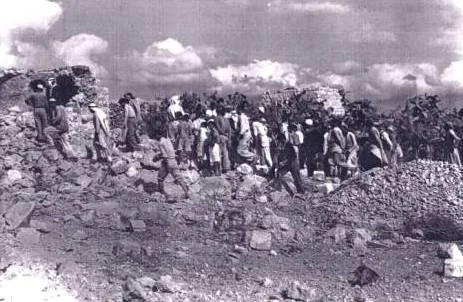
The UN party left Jerusalem around 6:30 a.m. on October 15. Commander E. H. Hutchison, acting chairman of the Israel–Jordan Mixed Armistice Commission, saw extensive damage at Qibya. Houses were wrecked, the school was destroyed, and civilian infrastructure had been hit. Witnesses described uniformed attackers. While Hutchison was there, residents were digging people out of collapsed homes. Twenty-seven bodies had been recovered by the time he left. That figure was a count from a search still underway. Vagn Bennike's October 27 briefing, paragraphs 18–27 · UN transcript in HTML.
Hutchison recorded bodies bearing gunshot wounds near doorways and bullet strikes on the doors of houses later demolished. He took that pattern as evidence that people had been forced to remain inside as buildings were destroyed. It was an investigator's inference drawn from what he found on the ground. It carries particular weight against Sharon's later account that his men thought homes had been emptied. The observations cannot give the last movements of every family. They establish what happened at doorways where civilians had been trying to survive. Hutchison's findings in the UN briefing · Sharon's later account to Prime Minister Levi Eshkol.
The commission attributed the raid to a force of Israel's regular army and recorded the related incursion into Shuqba and shelling of Budrus. It found breaches of article III of the armistice. Israel voted against the commission finding. The finding rested on several kinds of evidence together: testimony, the scale of the attack, the military character of the demolitions and the supporting attack beyond Qibya. When asked later about the claim that civilians from border settlements had been responsible, Bennike stood by his report. His team had found no record of border villages having the types of equipment that investigators identified. October 15 commission findings reproduced in the UN briefing · Bennike's November 9 answers and annexes.
How many were killed? On October 15 the commission recorded 42 dead and 15 wounded, with 41 dwellings and one school destroyed. In another passage of his October 27 briefing, Bennike cited 53 people killed. Jordan's delegate later gave 66 in the Security Council. Palestinian remembrance accounts and the Israeli army's later history commonly put the number at 67–69. AP reported that village records and memorials commemorate 77. These figures come from different records and dates. There is no verified reconciliation of every name and inclusion rule in the material reviewed here. The early count is evidence of the killings already documented. It gives no reason to erase a name the village remembers. UN briefing, commission decision and paragraph 42 · Jordan's later statement to the Council · WAFA's account · AP's reporting from Qibya.
What Ben-Gurion told the public
On October 19, Ben-Gurion said in a radio broadcast that Israel had investigated and found that every army unit had stayed at its base that night. He dismissed the allegation that 600 troops had taken part, cast the attack as an act by enraged frontier residents after Yehud, and laid responsibility for the situation on Jordan. Israel's representative Abba Eban expressed regret in the Security Council and argued that the violence should be seen in the context of insecurity along the frontier. In the November debate, Pakistan's representative pointed out that Israel had not produced the evidence of the investigation mentioned in the broadcast. The UN's finding did not depend on a claim that 600 soldiers had crossed the line. It identified a regular military force. Israeli Office of Information copy of the radio statement · Contemporary report of the broadcast · November 20 Security Council debate, paragraphs 44–48 and 66–70.
The records expose the central claim as false. The General Staff drafted a military order. Central Command issued its own. Sharon commanded the raid and filed an after-action report. Israel's own army later identified the participating units and gave a toll of 69 civilians. Sharett's October diary records senior officials privately discussing a planned operation while the public was told to picture an angry crowd. A government can change its account at a microphone. It cannot change the orders its officers wrote. Military orders and evidence of press handling · Sharett's private diary · IDF historical publication.
Twelve years later, the story changed again. In July 1965 Ben-Gurion publicly accused Lavon of ordering the army to harm civilians and said that the government had withheld the truth about the operation. Lavon and Dayan disputed his accusation. The Israeli military's History Department published Levi Eshkol's handwritten notes of a private September 3 meeting with Sharon. Sharon told Eshkol he had planned and led the raid. He said his force thought people had fled, and he acknowledged dozens died in houses. Sharon also recalled briefing Ben-Gurion shortly after the event and receiving approval of the outcome. These are later and at times competing accounts, given as the political fight over responsibility reopened. The 1965 cabinet discussion raised the idea of an inquiry. The editors of the published record found no operational decision from that meeting. Eshkol's September 3 notes and archival introduction, printed pp. 269–275.
The censure and what followed
On November 24, 1953, the Security Council adopted Resolution 101 by nine votes to zero, with Lebanon and the Soviet Union abstaining. The Council attributed the attack to Israel's armed forces, found that it violated the ceasefire and conflicted with the armistice and the UN Charter, and issued its strongest censure. It called on Israel to prevent a recurrence and on Jordan to continue and strengthen measures against unauthorized crossings. The resolution addressed both governments' obligations. It put responsibility for Qibya itself on the forces that attacked Qibya. Resolution 101, full text · UN vote record.
Britain had urged Israel to punish those responsible and offer compensation for death and damage. The United States publicly called for accountability on October 18. The aid record matters here. Washington had already deferred an economic allocation over Israel's separate Jordan River diversion dispute with Syria. On October 28, after Israel agreed at the UN to suspend the diversion work, Secretary of State John Foster Dulles recommended releasing roughly $26 million in earmarked economic aid. The US condemnation of Qibya and its aid decision ran on separate tracks. A request that the guilty be held to account was easier to make than an aid decision conditioned on that accountability. British request regarding punishment and compensation · US statement on the raid · US internal aid memorandum · Dulles's October 28 recommendation.
Bennike's March 1954 follow-up recorded increased border policing and continued violence. He reported no attack of comparable scale in the period since the resolution and found that the two sides still lacked the joint efforts the Council wanted. Individual punishment was outside the armistice commission's role. Resolution 101 did not order compensation or impose a criminal penalty. The records reviewed show demands for punishment and compensation. They leave open what, if anything, was delivered to specific families. Sharon stayed in the military and eventually became Israel's prime minister. Ghethan was still asking for a trial when AP interviewed him in 2014. Bennike's March 1, 1954 follow-up · UN questions on the commission's role · AP Archive in Qibya.
What the families are still owed
The people of Qibya have kept walking to remember the dead. AP recorded that tradition when it came to ask about Sharon, a man whose name was known around the world. The families knew other names. Mustafa by the olive trees. Latifa and her father Hussein. The six children in Mahmoud al-Masloul's family. The little boy Hamed trying to stay quiet among the people who were keeping him safe. Memory has done work that the officials with the files had the power to do much sooner. AP's record of the annual remembrance · Qibya residents' accounts.
Watchtower's judgment is simple. Killing the Kanias family was a crime against civilians. The Israeli command's decision to send soldiers against Qibya's homes was a wrong it had the power to prevent. The state owes the families the full orders and authorizations, any investigation or compensation records, and help preserving the names and testimony the village has kept alive. More than forty homes had to come down for the government to call it a reprisal. It took a radio address to deny it. Families have spent generations telling the truth about who was inside.
Sources and review notes
Public-record investigation and remembrance by DaddyBruce95. Reviewed November 21, 2026. This reconstruction uses survivor interviews, UN records, parliamentary and diplomatic material, personal diaries and historical research reproducing Israeli archival documents. Names may appear with different English spellings. The sources establish military responsibility and document several families' losses. A complete verified name roll, the identity of the officer who strengthened the Central Command wording, and a definitive record of individual penalties or payments to families remain open.
- AP Archive, January 2014 and Nadim Allawi, WAFA, October 2020 · Hamed Ghethan, village remembrance and family testimony.
- Jordan's October 16 letter to the UN · The first diplomatic account and reported family losses.
- UN Security Council, 630th meeting and 635th meeting · Field observations, early counts and the investigation of Yehud.
- Benny Morris's Qibya chapter, Efrat Zakbach's archival study and Moshe Sharett's diary · The political decision, General Staff and Central Command orders, and Sharon's command.
- November 20 Council debate and Eshkol's 1965 notes and introduction · The denial and the later dispute over responsibility.
- Resolution 101 and the March 1954 follow-up · The censure and subsequent UN monitoring.
Back to Watchtower · The 1948 Nakba · Remembering Kafr Qasim · Editorial standards and corrections