

True Justice · Editorial · November 21, 2026
On April 9, 1948, Irgun and Lehi fighters attacked Deir Yassin, a Palestinian village near Jerusalem. More than a hundred Palestinians were killed. The massacre came before Israel formally declared statehood and helped spread fear among Palestinians. During the 1947–49 war, roughly 750,000 Palestinians fled or were expelled in the Nakba. Families lost the homes they had built and the communities that had sustained them. For many, exile lasted the rest of their lives. UN history of the Palestinian question · UN humanitarian timeline · UN statement on the Nakba, May 2026
Look at what the Israeli state and its forces have done in the decades since. At Kafr Qasim, people returning home were shot under a curfew. At Qana, families who sought refuge under the United Nations flag were killed by Israeli artillery. In Gaza, Israeli strikes killed aid workers bringing food to people who needed it. An independent UN commission concluded that Israel committed genocide in Gaza. The names of the dead belong at the center of every argument about whether to supply the next weapon. The people signing the export licenses should have to read them.
The record starts in 1948
Kafr Qasim, October 29, 1956. Israeli Border Police shot residents during the imposition of a curfew. People returning to the village included workers who had been away when it was announced. Israel’s president, Isaac Herzog, asked forgiveness on behalf of the state in 2021 and commemorated 49 victims. He said the case had taught Israel’s security forces the duty to refuse a manifestly illegal order. Israeli military courts convicted members of the force. That duty belongs in every chain of command. So do consequences when officers give the order and subordinates carry it out. Israeli president’s memorial remarks and historical note · Israel Police historical account
The occupied Palestinian territory, from 1967. An army can take land in weeks. A government can spend generations turning that seizure into roads, barriers, settlement permits and a permanent order of control. In July 2024, the International Court of Justice concluded in an advisory opinion that Israel’s continued presence in the occupied Palestinian territory is unlawful. It said Israel must end that presence as rapidly as possible, immediately cease new settlement activity, evacuate settlers and make reparations. Palestinian freedom includes the right to decide their own future on their own land. ICJ summary of the 2024 advisory opinion
Qana, April 18, 1996. Israeli artillery hit a UN peacekeeping compound in southern Lebanon where civilians had taken shelter. More than 100 Lebanese civilians were killed. The UN military investigator acknowledged nearby fire by armed elements and examined Israel’s explanation. He found widespread impact across the compound and said the pattern made gross technical or procedural errors unlikely to explain it, while leaving that possibility open. Imagine taking your children to a peacekeeping base because you believe they will be safer there. Then read how much room the official record gives the people firing the shells to explain themselves. The families only had the shelter. UN investigation S/1996/337, especially paragraphs 9–12
The West Bank, Lebanon and Syria
West Bank. OCHA recorded 72 Palestinians killed in attacks by settlers between January 2023 and August 2026. It attributed 19 of the killings to Israeli forces, 36 to settlers and 17 to either forces or settlers where it could not assign responsibility more precisely. More than 6,500 people were displaced by settler attacks and access restrictions during the same period. During the 2026 olive harvest, OCHA recorded 428 settler attacks causing casualties or damage from September 1 through November 16. Some farmers were driven off land even after arranging access with Israeli authorities. The state has the power to control access and protect people. It must end settlement expansion and enforce the law against those attacking Palestinian families. OCHA’s West Bank displacement and casualty data · OCHA’s November olive harvest record
Lebanon. Thirty years after Qana, UN peacekeepers were still documenting Israeli strikes in the south. In November 2026, UNIFIL reported daily violations by Israeli forces despite a significant decrease in hostilities following a June agreement. It cited military activity, demolitions, airstrikes and artillery fire. On November 10, according to the UN, two Israeli tanks blocked a peacekeeping patrol and pointed their guns directly at the peacekeepers before the encounter was resolved through liaison. People trying to go back to southern Lebanon faced damaged homes and continued danger. The country’s sovereignty cannot depend on whether the Israeli military chooses to honor it on a given day. UNIFIL on conditions for returning residents · November 12 UN briefing
Syria. On November 28, 2025, Israeli forces entered Beit Jinn to arrest men accused of belonging to a terrorist organization. UN investigators documented clashes with armed residents, followed by Israeli shelling of the town. They found at least 11 civilians were killed and 25 injured, including a family of six killed in their home. The UN deputy special envoy condemned the incursion and reported that families fled to nearby areas. A raid has a stated purpose. A family's deaths demand an accounting for the decisions that put fire into a residential neighborhood. UN Syria Commission report A/HRC/61/62, paragraph 129 · UN deputy envoy’s statement
Gaza and the cost of waiting
Gaza, April 1, 2024. Israeli strikes killed seven World Central Kitchen workers traveling in three vehicles after unloading food aid. The dead were Saifeddin Issam Ayad Abutaha, Lalzawmi Frankcom, Damian Soból, Jacob Flickinger, John Chapman, James Henderson and James Kirby. The Israeli military acknowledged grave failures and dismissed two officers. Australia’s special adviser concluded the strikes were not knowingly directed against World Central Kitchen, and documented failures in identification, coordination and decision-making. The people preparing the next export license should read the account of how three marked aid vehicles were struck in succession. World Central Kitchen’s remembrance · Australia’s review of the strikes and Israel’s investigation
In September 2025, the independent UN Commission of Inquiry concluded that Israeli authorities and security forces had committed genocide against Palestinians in Gaza. It examined killings, serious bodily and mental harm, conditions of life calculated to bring about physical destruction and measures intended to prevent births. It found genocidal intent. Israel rejected the report, accusing the Commission of bias and selective evidence. The separate genocide case at the International Court of Justice is pending. The Commission called on governments to stop transfers of arms and other items when there is reason to suspect they could be used in operations involving genocide. Governments have that warning in writing. Commission findings and recommendations, particularly paragraph 257(b) · Israel’s response · ICJ scheduling order
The Commission returned to the record in October 2026. It found continued genocidal acts and intent in the cases it examined after the October 2025 ceasefire. The report records Israel’s claim that its attacks responded to ceasefire violations. It also documents what happened to Palestinians. On November 12, after that report, an Israeli strike hit the surgery department at Nasser Medical Complex. The WHO reported six people killed, and Médecins Sans Frontières said the strike came without warning. Israel said its strike targeted a Hamas commander and claimed military use of the hospital. It said it had previously demanded an end to military activity there and took steps to limit harm. Whether a warning reached the people at risk in time to protect them remains disputed. The law protects patients and medical staff and imposes duties of warning where applicable, distinction, proportionality and precaution. A hospital’s patient list does not stop mattering when the military issues a statement. October 2026 Commission report, paragraphs 33 and 54 · OCHA, citing WHO on Nasser · MSF field statement · Israeli military statement · ICRC on hospital protections
Deir Yassin was attacked by pre-state forces. Kafr Qasim was a police massacre. Qana was an Israeli military bombardment, and Gaza is the subject of a genocide finding by a UN inquiry. Each deserves its own record. Together they show why promises of restraint are inadequate. Across generations, Israeli institutions have exercised armed power over Palestinians and their neighbors with consequences that civilians have been left to bear. Governments that can stop replenishing that arsenal have a choice right now.
Stop the weapons at the source
In February 2026, Congress appropriated at least $3.3 billion in Foreign Military Financing grants for Israel and $500 million for Israeli cooperative programs. SIPRI measured the United States as the source of 68 percent of Israel’s imports of major conventional arms in 2021–25, and Germany as the source of 31 percent. Those shares measure major arms transfers under SIPRI’s methodology. Israel also makes weapons domestically. Its Defense Ministry announced $19.2 billion in new defense export contracts signed in 2025 and promoted demand for systems used in combat. U.S. funding, foreign transfers and Israeli production are different channels. A serious policy has to address all three. U.S. appropriations law, Div. F §7041(c) and Div. A §8071 · SIPRI’s March 2026 transfer figures · Israeli Defense Ministry contract announcement
On November 3, 2026, President Donald Trump said he intended to end annual U.S. military aid in 2027 while continuing to sell weapons to Israel. U.S. and Israeli officials subsequently told The Times of Israel that negotiations remained unresolved and the administration planned to honor existing commitments as much as possible. The announcement itself did not rescind the enacted funding or create an embargo. If Israel can buy the same weapons after a grant ends, the weapons can still reach the same forces. Congress must address sales and shipments as well as subsidies. Fox News interview, November 3 · Times of Israel follow-up, November 13
In April 2024, the UN Human Rights Council called for a halt to arms transfers to Israel. Governments can act through their own laws today. Spain’s 2025 decree restricts listed defense and dual-use trade with Israel, with a limited cabinet exception. Britain suspended about 30 export licenses in September 2024 after finding a clear risk that certain items might be used to commit or facilitate serious violations of humanitarian law. It carved out much of the shared F-35 supply chain. That exception illustrates the problem. An embargo that ends at a warehouse door leaves the same equipment circulating under a different invoice. Human Rights Council resolution 55/28 · Spain’s decree · UK licensing decision and its F-35 exception
Governments should enact and enforce an embargo covering hardware, ammunition, military parts, maintenance contracts and third-country transfers to the Israeli military. End grants and other public financing, suspend pending deliveries under applicable law and block replacement sales financed through other means. Publish authorizations and actual shipments separately. Identify the end user, enforce the restrictions and report violations. Preserve civilian humanitarian trade, medical supplies, food, water infrastructure and independent relief access. The measure of an embargo is what reaches the military, and what reaches the people it is meant to protect.
Take the arsenal out of service
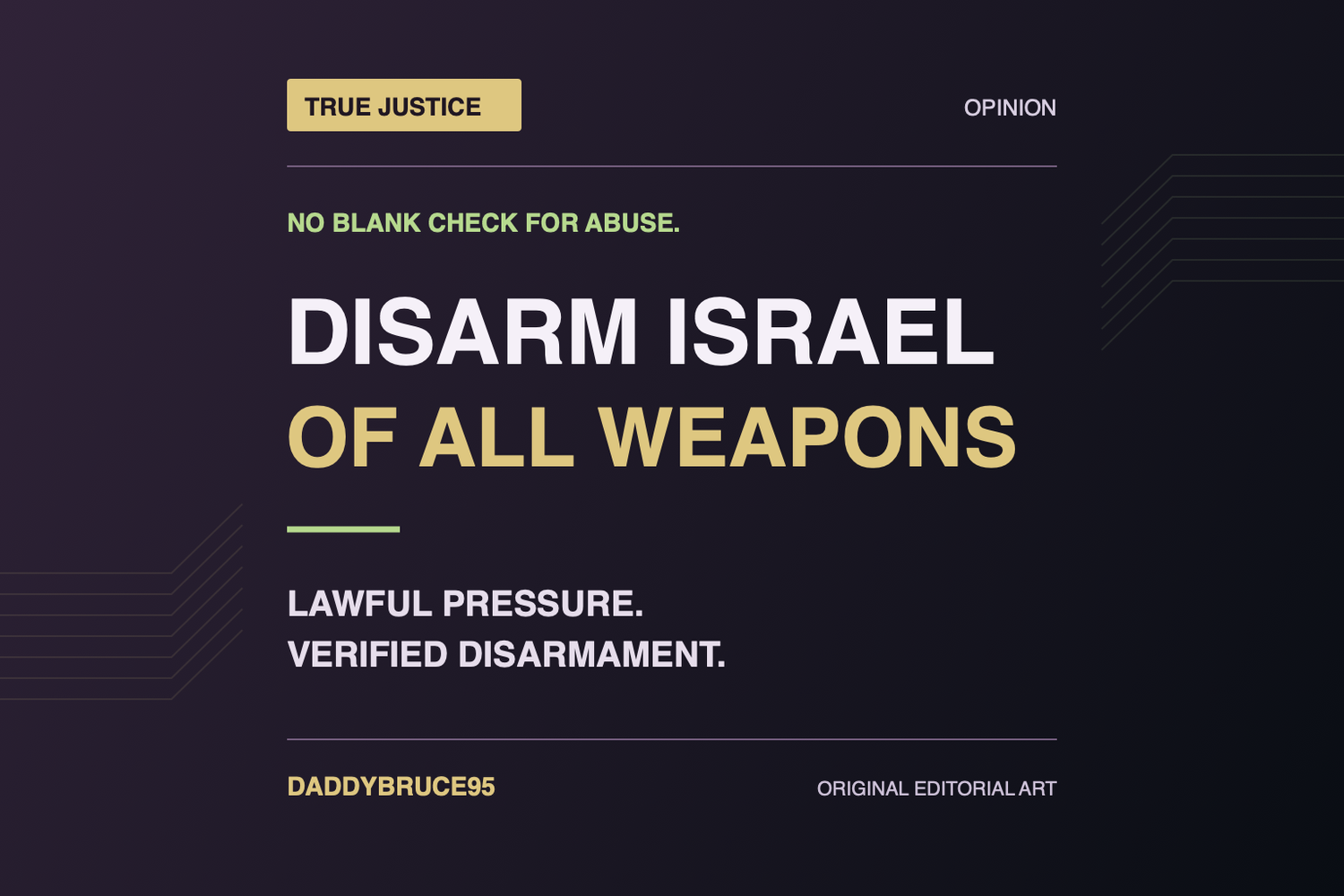
An embargo cuts off replenishment. A disarmament agreement takes the arsenal already in service out of military use. True Justice is calling for both. Pursue a binding agreement that covers conventional and nuclear weapons, restricts new military production and acquisitions, requires an inventory and sets a staged, independently verified timetable for elimination. The agreement should establish oversight, consequences for violations and ways to settle disputes without restarting the war. Neither a press release nor an assurance from the same authorities being inspected can verify compliance.
SIPRI estimated that Israel had around 90 nuclear warheads in January 2026. Israel does not publicly confirm or deny possessing them and remains outside the Nuclear Non-Proliferation Treaty. It has limited safeguards arrangements with the IAEA. In September 2026 the IAEA General Conference called for full-scope safeguards and an effectively verifiable regional nuclear-weapon-free zone. Israel says regional arms control must be negotiated by the affected states and tied to wider security and peace. Governments can negotiate those guarantees now and require a dated path to declarations, inspections and verified elimination. Article 4 of the Treaty on the Prohibition of Nuclear Weapons offers an existing legal model for a nuclear-armed state joining with a binding elimination plan. The demand is for Israel to accept that kind of obligation. SIPRI’s January 2026 estimate · IAEA safeguards report and Israel’s position · September 2026 IAEA resolution · Nuclear prohibition treaty, Article 4
Every civilian has a right to protection, including people now relying on shelters and interception systems. A staged agreement must put credible ceasefires, civilian safeguards, regional commitments against cross-border attacks and independent monitoring in place as systems are retired. Palestinian rights, humanitarian access and an end to unlawful occupation cannot be postponed until the last weapon is gone. Peace means a Palestinian child can go to sleep without fearing the next Israeli strike, and an Israeli child can go to sleep without fearing the next rocket. An agreement should be judged by whether it makes that possible.
Make your government answer
Ask your representatives for a recorded position on an embargo, military aid and a successor to any existing arms commitments. Ask what was authorized, what was delivered, and who can suspend the pending transfers. In April 2026 the U.S. Senate rejected motions to bring two specific sale-blocking resolutions out of committee. One resolution concerned a sale involving military bulldozers, the other a sale involving bomb bodies. The roll calls list how each senator voted. Ask yours what they will do before the next proposed sale goes forward. Back independent investigations, preservation of records, reparations and prosecutions where the evidence warrants them. Senate roll call on the bulldozer resolution · Senate roll call on the bomb sale resolution · Find your U.S. representative · Find your U.S. senators · DaddyBruce95 Take Action
At Deir Yassin, people lost their families and their homes. At Kafr Qasim, workers never made it home. At Qana, Israeli shells killed families inside a shelter. At Beit Jinn, a family of six was killed at home. In Gaza, seven people went out to deliver food and never came back. Every arms vote made in full knowledge of this record deserves to be public. Cut off the weapons. Put disarmament under verification. Make the officials who ordered or enabled crimes answer to the law.
Read the record. Gaza Reading Guide · Lebanon Reading Guide · The West Bank Olive Harvest Under Attack · Israel Has Nuclear Weapons · The UN findings on Gaza after the ceasefire · Editorial standards and corrections